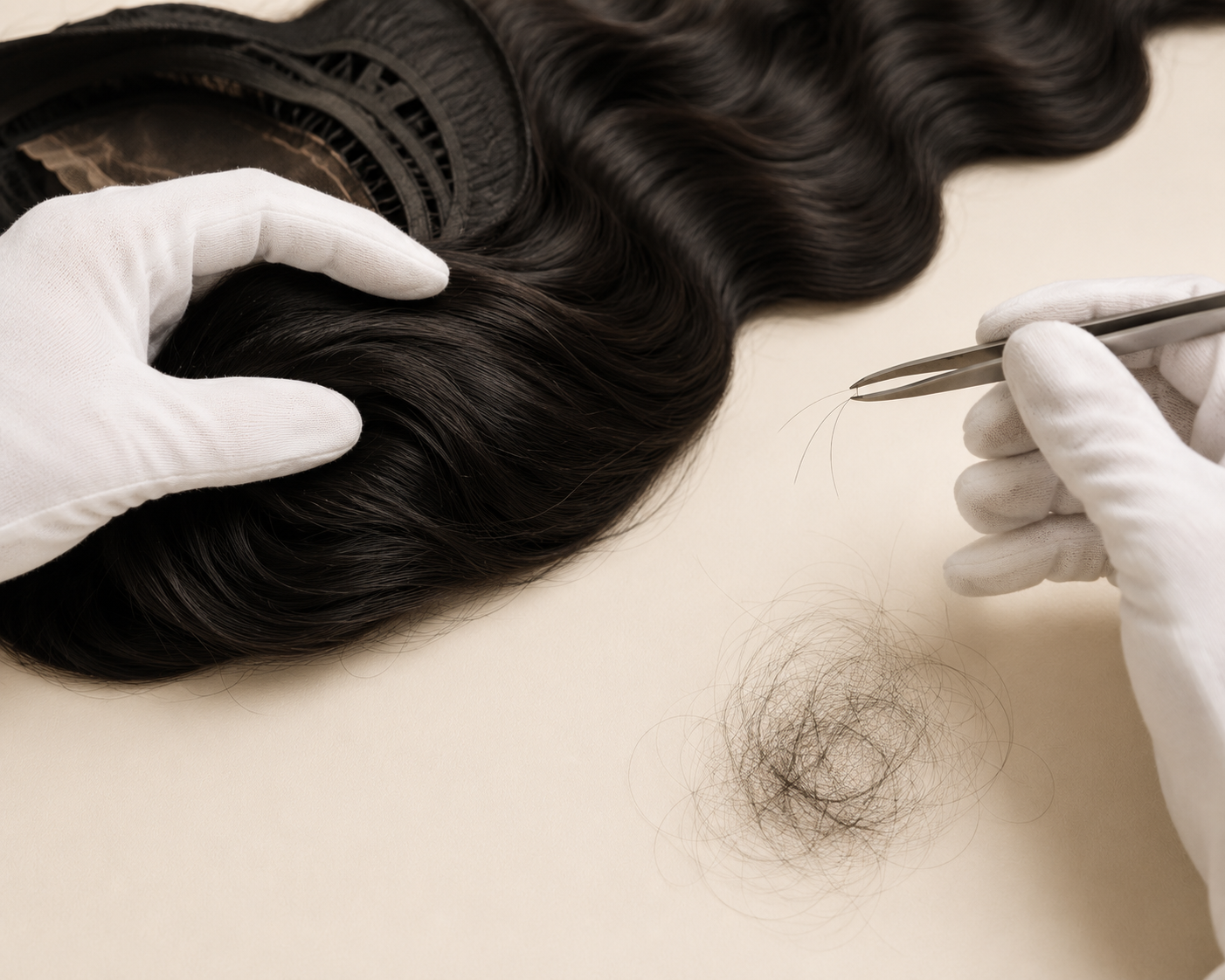
AA WIGS Body Wave — quality inspection showing precisely what shed hairs look like versus the weft-secured hair that stays in place.
Normal Shedding vs. Excessive Shedding
Every human hair wig sheds. This is not a defect statement — it is a factual one. During manufacturing, thousands of individual hairs are sewn into weft tracks and then sewn onto a cap. A small number of hairs that were not fully anchored will work their way free during the first few wears. This is break-in shedding, and it is completely normal.
What the industry rarely explains clearly is where normal ends and excessive begins.
The clearest test: hold the wig up to natural light at the crown and sides after 4–6 wears. If coverage looks the same as when you first opened it, shedding is within normal limits. If the hair looks noticeably thinner at any section, something is wrong — either with the construction or with how it has been handled.
What Actually Causes Shedding
Shedding comes from one of two places: the wig, or the person wearing it. Both are worth understanding.
From the wig itself
- Unsealed weft edges — the most common manufacturing cause. When the cut ends of a weft are not sealed, individual hairs have no barrier holding them to the track. They pull free with any tension.
- Loose weft stitching — if the thread tension on the cap stitching is inconsistent, the weft shifts under use and hairs escape at the gaps.
- Low-quality hair blends — wigs sold as "100% human hair" sometimes contain a percentage of synthetic fiber mixed in to reduce cost. Synthetic fiber does not anchor the same way human hair does and sheds more aggressively under heat and brushing.
- Over-processed hair — hair that has been bleached, permed, or colored without correct neutralization is chemically weakened at the shaft. The hair breaks rather than sheds, but the result looks identical.
From handling
- Detangling from the root instead of from the ends upward
- Using a fine-tooth brush instead of a wide-tooth comb or fingers
- Pulling through tangles instead of working them out section by section
- Wringing the wig after washing instead of gently squeezing
- Applying heat directly to the weft track at the hairline
Handling Mistakes That Make It Worse
Most mid-wear shedding — the kind that appears after a wig has been used correctly for several weeks and suddenly starts dropping more hair — is handling-related. The single most damaging habit is detangling incorrectly.
AA WIGS Tip: Always detangle starting from the ends, working upward in small sections toward the root. Never pull a comb from root to tip through a tangle — this yanks multiple hairs free from the weft at once and compounds over time.
Washing technique matters equally. Human hair on a wig does not grow from a scalp, so it does not have sebaceous glands re-lubricating it. Aggressive rubbing during washing strips the cuticle and weakens the hair at its attachment point. The correct method: saturate with water, apply sulfate-free shampoo, and squeeze gently downward — never scrub side to side.
Heat applied directly above or on the weft track — particularly at the hairline where lace meets the weft — degrades the thread holding the wig together. Style the hair itself, not the root area where the track sits.
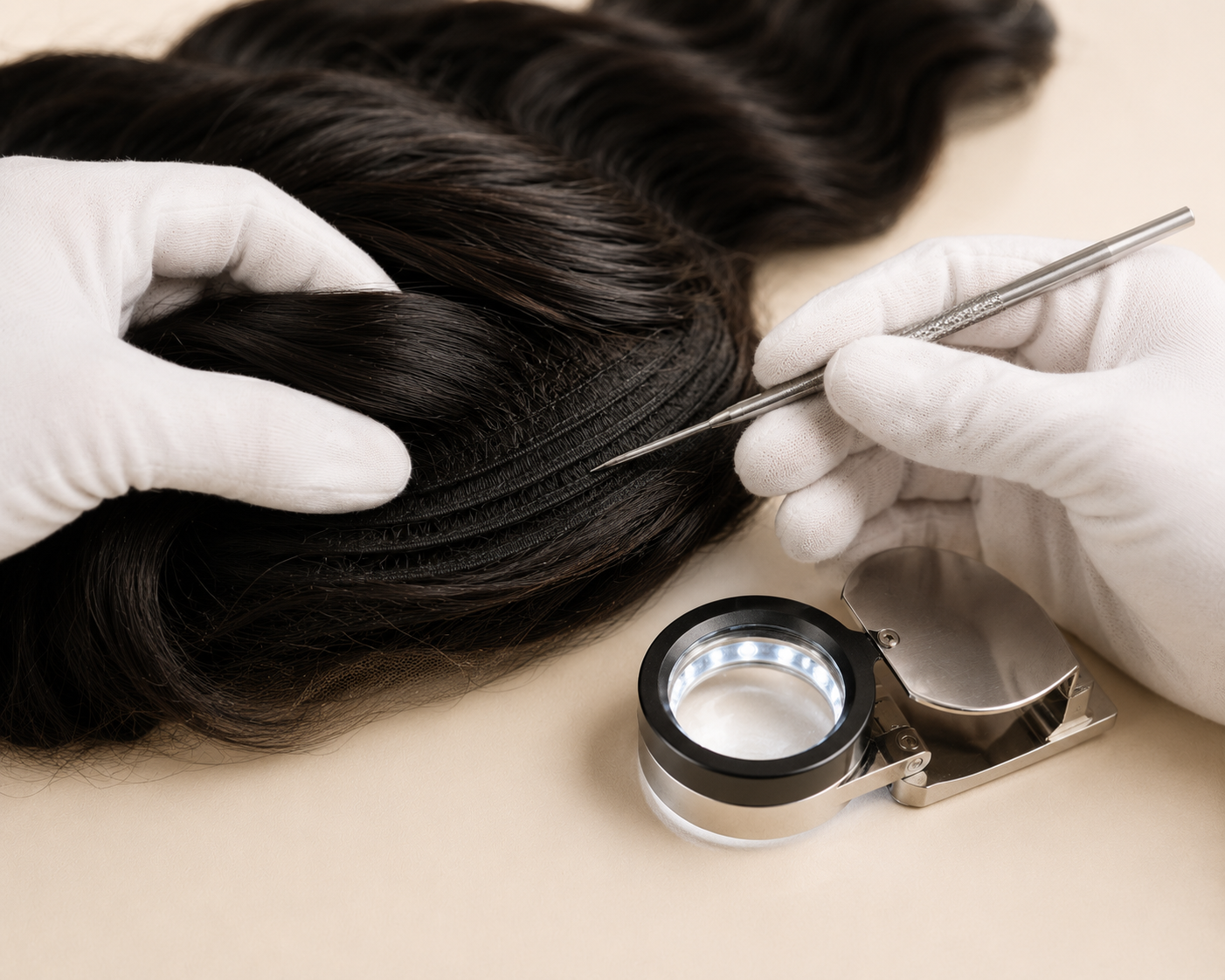
AA WIGS quality inspection — weft track stitching examined under magnification before every unit is approved for shipment.
What Shedding Reveals About Quality
Minimal break-in shedding tells you nothing meaningful about a wig's quality. Continuous shedding — shed that does not resolve after the first few wears and normal handling — tells you almost everything.
A weft that is properly constructed and correctly sealed holds its hair under normal use. When a wig sheds persistently regardless of how carefully it is handled, the cause is almost always in how the weft was finished before it left the factory. There is no correction for improperly sealed wefts after purchase. The only solution is a wig built correctly from the beginning.
This is why quality control at the weft level — not just visible inspection of the hair — is part of what determines whether a wig performs over months of wear or begins visibly thinning within weeks.
How to Reduce Shedding
- Detangle before washing — never try to detangle wet hair; it is at maximum elasticity and most likely to break or pull free
- Use a wide-tooth comb or fingers only — fine-tooth brushes create friction across the entire length of the hair simultaneously
- Wash in downward strokes — always squeeze water and product through the hair in the direction of the cuticle, top to bottom
- Air dry whenever possible — heat from a dryer concentrates at the root and weft area and degrades the stitching over time
- Store on a wig stand — a wig lying flat in a bag tangles and the resulting pull when detangling causes unnecessary shed
- Seal persistent shed spots — if one area of the weft consistently sheds, a small amount of clear flexible wig sealant applied to the underside of that weft track stops further loss without affecting the hair's appearance
The AA WIGS Standard
Every AA WIGS unit is inspected at the weft level before it ships. Weft stitching is checked for consistency across the full cap, and weft edges are sealed as part of the production standard — not as an optional finishing step.
If a unit shows any sign of weft loosening or inconsistent stitching during inspection, it does not ship. The 22" Signature Swiss HD Body Wave is built to perform over time under real use conditions, not just look correct in unboxing.
Weft integrity, stitching consistency, and edge sealing are checked on every unit before it reaches a client.
Read the full AA WIGS Quality Standard →Frequently Asked Questions
Is it normal for a human hair wig to shed?
Yes — minimal shedding during the first few wears is normal as loose hairs that were not fully secured during manufacturing work their way free. Continuous heavy shedding after the break-in period, or shedding that causes visible thinning on the cap, is not normal and indicates a construction or handling issue.
What causes a wig to shed excessively?
Excessive shedding comes from one of four causes: unsealed weft edges at the factory, aggressive detangling from roots instead of ends, heat damage that weakens the hair shaft, or chemical processing that was not correctly neutralized. Low-quality wigs shed because the wefts were never sealed. High-quality wigs shed when handled incorrectly.
How do I stop my wig from shedding?
Detangle from ends upward using a wide-tooth comb or fingers. Never pull through tangles from root. Avoid excessive heat on the weft area. Wash with downward squeezing strokes, not rubbing. Air dry when possible. For persistent shedding at one location, apply a small amount of clear wig sealant to the weft underside at that spot.
Does shedding mean my wig is low quality?
Not automatically. Minimal early shedding is manufacturing-normal. Consistent ongoing shedding after the first few wears — especially when handling has been correct — is a reliable indicator of a construction issue. A properly built wig with sealed wefts and verified stitching should not shed continuously under normal use.
Can washing make shedding worse?
Yes, if done incorrectly. Rubbing the hair during washing, washing against the direction of the cuticle, or wringing the wig all create friction that pulls hairs free from the weft. Always squeeze water and shampoo through the hair in a downward direction — never scrub or wring.
Related Articles
- Why Does My Wig Tangle? Causes and How to Prevent It
- The AA WIGS Quality Standard: What We Check Before Every Wig Reaches You
- How To Refresh Your Body Wave Between Washes
- The Cuticle Is Everything: What Virgin Human Hair Actually Preserves
- Is This Normal? — diagnostic thresholds for every common concern
- Buying With Confidence — the complete AA WIGS trust hub →
- Browse All Knowledge Center Articles →
Shedding is one of the most preventable problems in wig wear — when you know what causes it and what good construction looks like before you buy. To understand every quality check that happens before an AA WIGS unit ships, read the AA WIGS Quality Standard.
If you have questions about your unit or want guidance on care technique, the AA WIGS Concierge is available to help.